What Autodesk's $3.6B MaintainX Acquisition Means for Engineering Firms
Autodesk's $3.6B MaintainX deal signals engineering firms are becoming tech-enabled professional services firms. What it means, plus the 40-45% pay premium.

This week Autodesk agreed to spend $3.6 billion on a maintenance app. Not a design tool. A work-order app.
Autodesk makes the software your modelers open every morning: Revit, Civil 3D, AutoCAD. On May 28 it agreed to buy MaintainX, an app firms use to track work orders, assets, inspections, and maintenance. The price was about $3.6 billion, all cash (PR Newswire, May 28, 2026). It is not a small bet, either. MaintainX runs more than $135M in recurring revenue and is growing over 50% a year.
So why does a design-software company pay that much for the least glamorous link in the chain, the part that starts after the building opens?
Because Autodesk is buying the "operate" phase. It even built a division to hold it, called Autodesk Operations Solutions.
How I read it
This is not one deal. It is the last move in a decade of them.
Autodesk now owns every stage
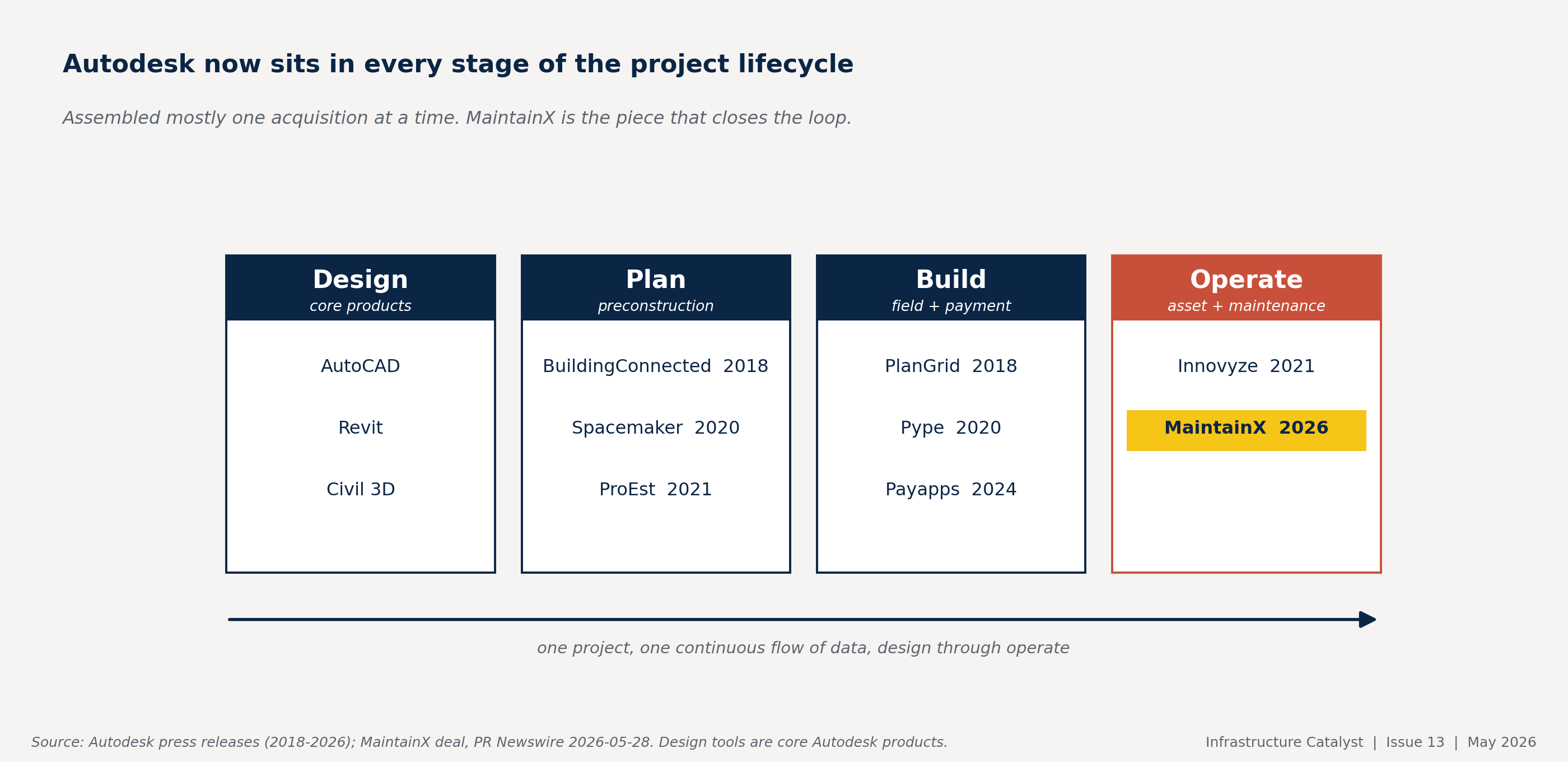
Look at the chart above. A construction project moves through four rough stages: you design it, you plan and bid the preconstruction, you build it, and then someone operates the finished asset for decades. One acquisition at a time since 2018, Autodesk has bought its way into every one of those stages. PlanGrid in 2018 for $875M and Pype for the field, BuildingConnected and ProEst in 2021 for preconstruction, Innovyze in 2021 for $1B for water operations, and now MaintainX in 2026 for $3.6B for maintenance. The design tools were always theirs. What is new is that they own the entire line, and MaintainX is the piece that closes it.
Autodesk says the goal is to "converge design, make, and operate workflows" so data "flows seamlessly in a continuous lifecycle." In plainer words: they are building the system that carries a project from a model, into a building, and through 30 years of maintenance. Not the drawing. The system underneath the drawing.
The judgment no one wrote down
That continuous lifecycle has a flip side most of us already feel, because today the same information gets re-entered across the stack four or five times before a project ever closes. The submittal lives in Procore, the spec reference in Bluebeam, the RFI in an email thread, the as-built in someone's field book, and the closeout in a PDF that nobody reopens, so every hand-off becomes a quiet place for the knowledge to leak and one more reason a junior engineer has to walk back to a senior one and ask what it meant.
Autodesk can sell a firm the pipes that move its data. It cannot sell a firm its own judgment.
That judgment was never written down to begin with. It lives in the heads of the senior engineers, and a little of it walks out the door every time one of them takes a week of PTO.
Lately, though, they are not just taking PTO. They are retiring. The NCCER estimates that about 41 percent of the construction workforce will retire by 2031, and the Associated Builders and Contractors put the 2025 shortfall at 439,000 workers the industry needed and could not find. Only about one in ten construction workers is now under 25, and ASCE has been raising the same alarm for civil engineering specifically. So the judgment that was never written down is leaving the building for good, at the exact moment the industry is shortest of the young people who would normally absorb it. A firm that kept everything in its seniors' heads is about to learn how many of those heads it is losing, and how little of what they know was ever captured anywhere a model, or a new hire, could read it.
The shift underneath the work
Step back, and the shift is bigger than Autodesk, and simple to name even if it is hard to do. No engineering firm is about to stop designing roads and start selling software. The core work is not going anywhere. What changes is the system running underneath it. The firms pulling ahead have quietly started treating that system as part of what they deliver, writing down what their senior people carry in their heads instead of letting it retire with them. They are becoming tech-enabled professional services firms without ever announcing it, doing the same work on a new delivery system.
The same thing changes the ground under the individual engineer. The way to stand out used to be command of the deliverable, the cleaner set of plans and the tighter schedule, and that still matters. What is added on top is the engineer who can take a piece of the work that lives in one person's head and turn it into something the team can run without that person in the room. That is the capability firms have started to pay a real premium for, and it is the one worth building toward. The work stays the work. The system underneath it is the new ground, and the people who can build it are the ones who pull ahead.
Joseph Dib, PE, PMP
Infrastructure Catalyst