The Smartest Revolution in History Can't Find Enough People to Build It
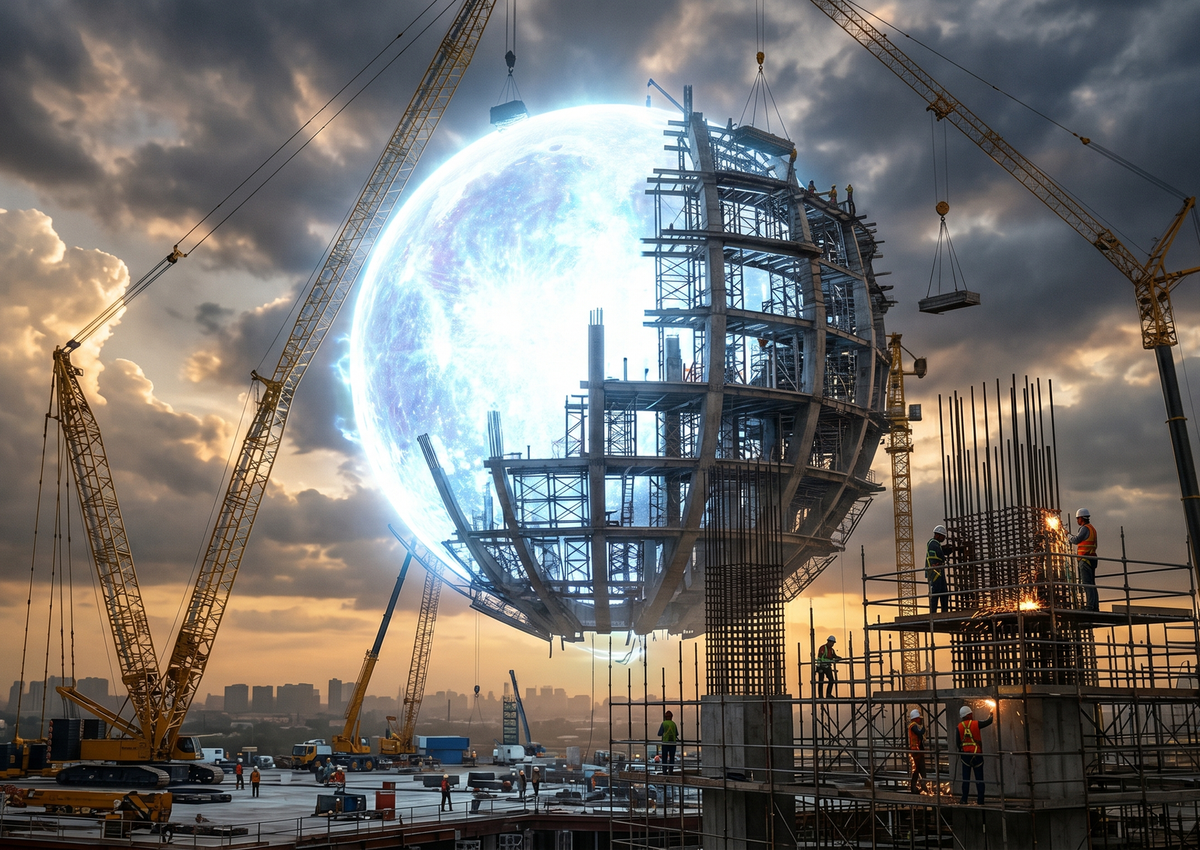
The story nobody is telling is how the construction industry will reshape AI.
Infrastructure Catalyst
Issue #10 | April 14, 2026
The story so far has been about how AI will reshape the construction industry. The story nobody is telling is how the construction industry will reshape AI.
The Debate
Something unusual happened in January. Three of the most powerful people in artificial intelligence sat on a stage at Davos and publicly disagreed about the future of their own field.
Dario Amodei, the CEO of Anthropic, said human-level AI could arrive in 6 to 12 months. Demis Hassabis, the CEO of Google DeepMind, said there was a 50% chance within the decade but that one or two more breakthroughs were needed. Yann LeCun, Meta’s chief AI scientist, said current AI systems will never reach human intelligence.
They were arguing about something called the singularity.
The idea is 60 years old. In 1965, a mathematician named I.J. Good asked a simple question: what happens when a machine becomes smart enough to design a machine smarter than itself? His answer was that the process would repeat, each generation designing the next, accelerating beyond our ability to predict or control. He called it an intelligence explosion.
Ray Kurzweil turned that idea into a timeline. He has predicted since 1999 that machines will match human intelligence by 2029 and that by 2045 the merger of human and machine intelligence will be complete. He reaffirmed both dates in his 2024 book.
Sam Altman called it a gentle sunrise.
You do not need to pick a side. But you need to know that every side agrees on one thing: whatever the timeline, getting there requires physical infrastructure at a scale the world has never attempted. And that is where this stops being a tech story and starts being a construction story.
The Money
In 2026, four companies plan to spend a combined $700 billion on capital expenditures. About 75% of that is going directly into AI infrastructure: data centers, power generation, grid connections.
To put that in context, the entire US interstate highway system cost roughly $530 billion in today’s dollars. These four companies will spend more than that in a single year.
These are not software companies buying cloud credits. They are construction clients building power plants, pouring foundations, and pulling wire. Construction starts hit $25.2 billion in January alone, the highest monthly figure since recordkeeping began.
A single large AI training facility requires 100 to 1,000 megawatts of dedicated power. That is the electricity demand of a small city. The IEA projects data center power consumption will equal Japan’s entire electricity output in 2026.
The scale is unprecedented. So are the obstacles.
The Bottleneck
Half of planned US data center builds have been delayed or canceled in 2026. Not because the technology failed. Not because the funding fell through. Because the physical infrastructure to support them does not exist yet.
The single biggest chokepoint is electrical equipment.
Two completed data centers in Silicon Valley cannot operate because the electrical equipment to connect them to the grid has not arrived. The buildings are finished. The servers are ready. They are waiting on a transformer.
Behind the equipment shortage is a workforce shortage. The construction industry is 439,000 workers short, and single data center campuses now require 4,000 workers instead of the 750 that were standard a few years ago. The electricians wiring these campuses are the same ones building hospitals, water treatment plants, and highway interchanges. There are not enough of them for all of it.
And then there are the communities. In Festus, Missouri, voters recalled their entire town council over a $6 billion data center proposal. Across 24 states, $64 billion in data center projects have been blocked or delayed by local opposition.
The Construction Users Roundtable put it plainly: “The bottleneck in AI is not the algorithm anymore. It is the build-out.”
The Shift
To meet projected AI demand, the world needs to add roughly 80 gigawatts of new power generation every year. That is the equivalent of building 80 nuclear power plants annually, about twice the pace of the last decade. By 2030, the total investment needed is estimated at $7 trillion.
That money is already looking for the people who can build it. Electricians on data center projects earn 32% more than typical construction wages. Contractors report backlogs close to a year. Amazon, Microsoft, and Google are each investing hundreds of millions in workforce training because they cannot build fast enough with the labor that exists.
This is the largest construction opportunity in a generation. What gets built in the next five years will shape what AI can and cannot become.
Meanwhile, 76% of AI researchers say the performance gains from making models bigger have plateaued. The next wave of progress depends not on better algorithms but on the physical infrastructure those algorithms run on. The constraint shifted. And it shifted toward the people who build things.
The three men on that stage in Davos disagree on whether the singularity arrives in months, years, or never. But none of them control the timeline. It depends on whether the grid, the workforce, and the supply chain can scale fast enough, and whether communities will accept what the technology demands.
The governing constraint is not software or silicon. It is whether the physical world can be built fast enough. That will determine whether the singularity arrives in 5 years or 50.
The future was supposed to be software. It turns out, it is concrete.
Joseph Dib, PE, PMP
Infrastructure Catalyst