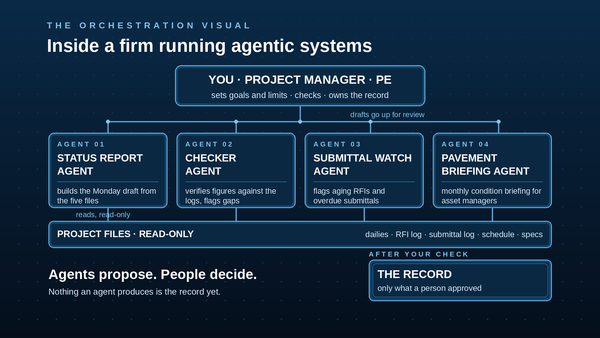
How much access should an AI agent have on project work?
Keys to specific rooms. Never the kingdom.

For a long time, an AI agent was something you had to go looking for. Now they are generally accessible, more companies are handing them real work, and the shift is easy to miss because it does not arrive as one decision. It arrives as more doors left unlocked.
I call it the keys rule. The agent gets as much access as the task earns, and not a key more. Keys to specific rooms. Never the kingdom.
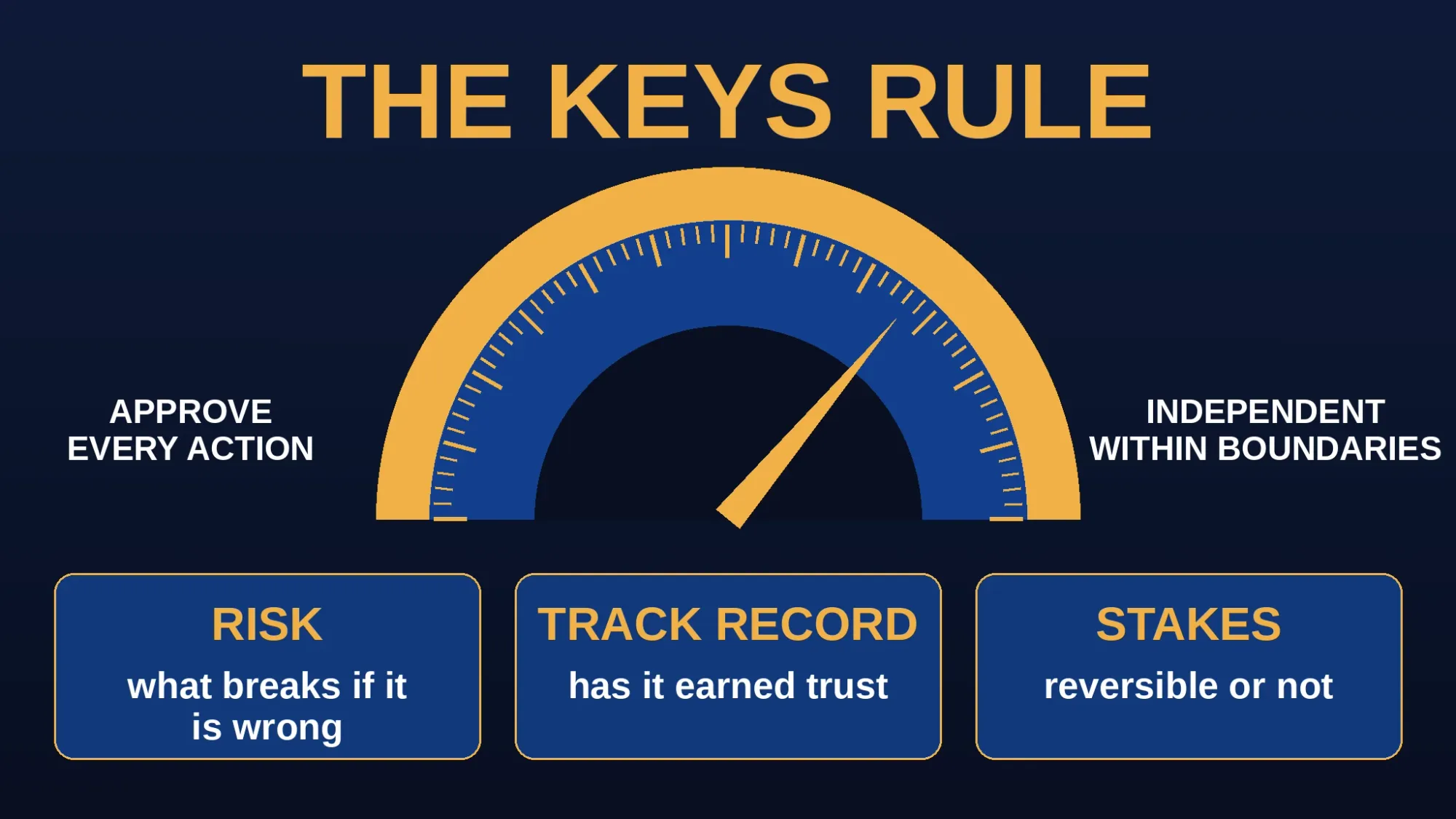
The rule runs on a dial from "approve every action" to "independent within boundaries." You set it per task using three factors. Risk and reversibility: what breaks if it's wrong, and can you undo it? The agent's track record: has it earned trust on this kind of work? Environmental stability: a standard spec section versus a first-of-its-kind design. Here is the part nobody wants to hear: nobody hands the agent the kingdom. You just stop locking the doors. Autonomy expands by drift, not by decision. You get busy, you stop checking, and one day the agent is deciding things you never agreed it could decide. The fix is a default. The dial has a documented resting position, and anything wider needs a deliberate decision. Not a busy Tuesday. Keys, not the kingdom: the agent gets freedom inside boundaries you drew, never the run of the place. In engineering terms, we already have a dial. It's called the stamp.
On a real job, it looks like a condition summary versus next year's work plan. Same agent, two rooms, different keys.
Wide dial: the agent turns field ratings into a draft condition summary. PCI scores, a list of sections that dropped a category, a flag that last year's overlay is already cracking. If a sentence is off, you edit it. The data already exists, and the write-up is reversible.
Narrow dial: the same agent is asked to recommend which segments get overlay, mill-and-fill, or do-nothing in next year's program. Or it drafts the dollar split across the network. That moves budget and concrete. The agent can rank sections and show the tradeoffs. It does not pick the program, and it does not send it to the city or the DOT.
The mistake is running one dial position for both jobs. Either you approve every keystroke, which is the review bottleneck from the first edition, or you let the agent roam because checking felt like too much work, which is abdication with better branding.
The hard part is not the framework. It's letting go. My stamp is on the work whether an agent drafted it or I did, so handing over a task never hands over the responsibility. If I ran it on feel, I would check everything, or on a busy week, nothing. The written dial exists so a feeling does not get to set it. My dial settings are written down now. Research agents run wide: gather, summarize, cite sources, never publish. Draft agents run medium: draft in my voice, from my brief, and everything comes back in a fixed-shape report. Anything outward, a post, a send, a schedule, a number I'll state publicly, is narrow dial: nothing moves without my explicit approval. That's not paranoia. It's governance. The standing rule predates any book; the practice just finally has a name. The other setting: every dial position gets reassessed on triggers. An agent that earns three clean runs gets a wider dial. One miss narrows it again. Trust is a track record, not a vibe. What's sitting on "approve everything" in your workflow that could move one notch wider? Hit reply and tell me. Ideas adapted from The Human-Agent Orchestrator (Bornet, Wirtz et al., 2026).