Can AI Check Civil Engineering Work for Errors? The Bentley Brief
Bentley Copilot, STAAD.Pro MCP server, ProjectWise FedRAMP
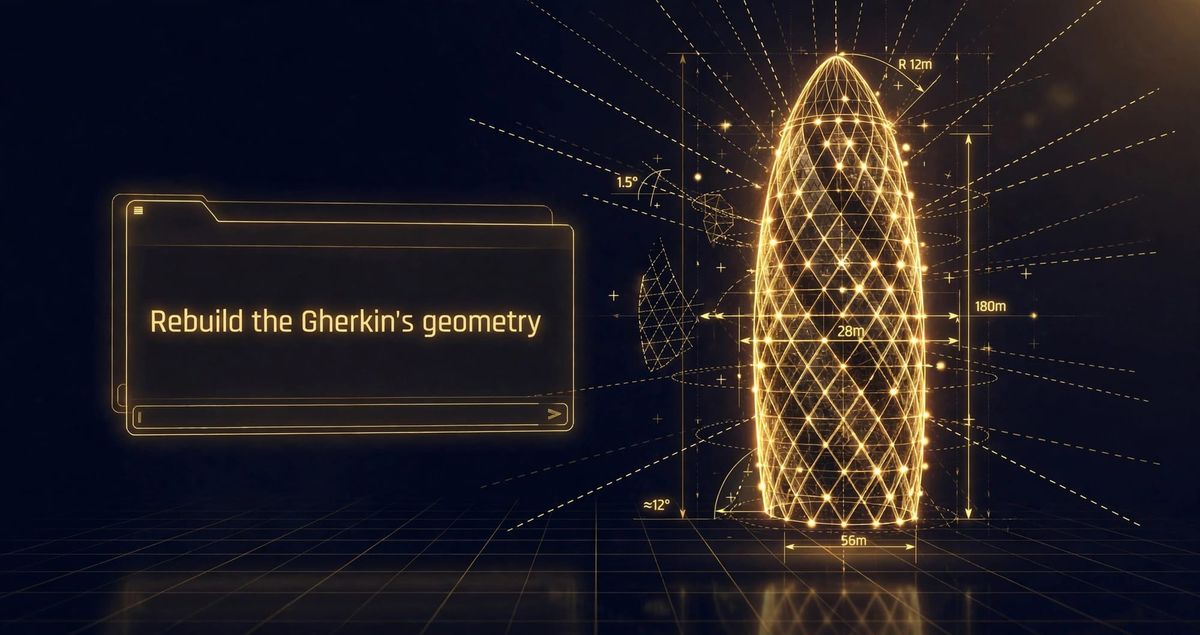
One text prompt rebuilt the Gherkin's geometry in Bentley's demo. The next model it builds could be yours. Who checks it? You do, the same way you always have.
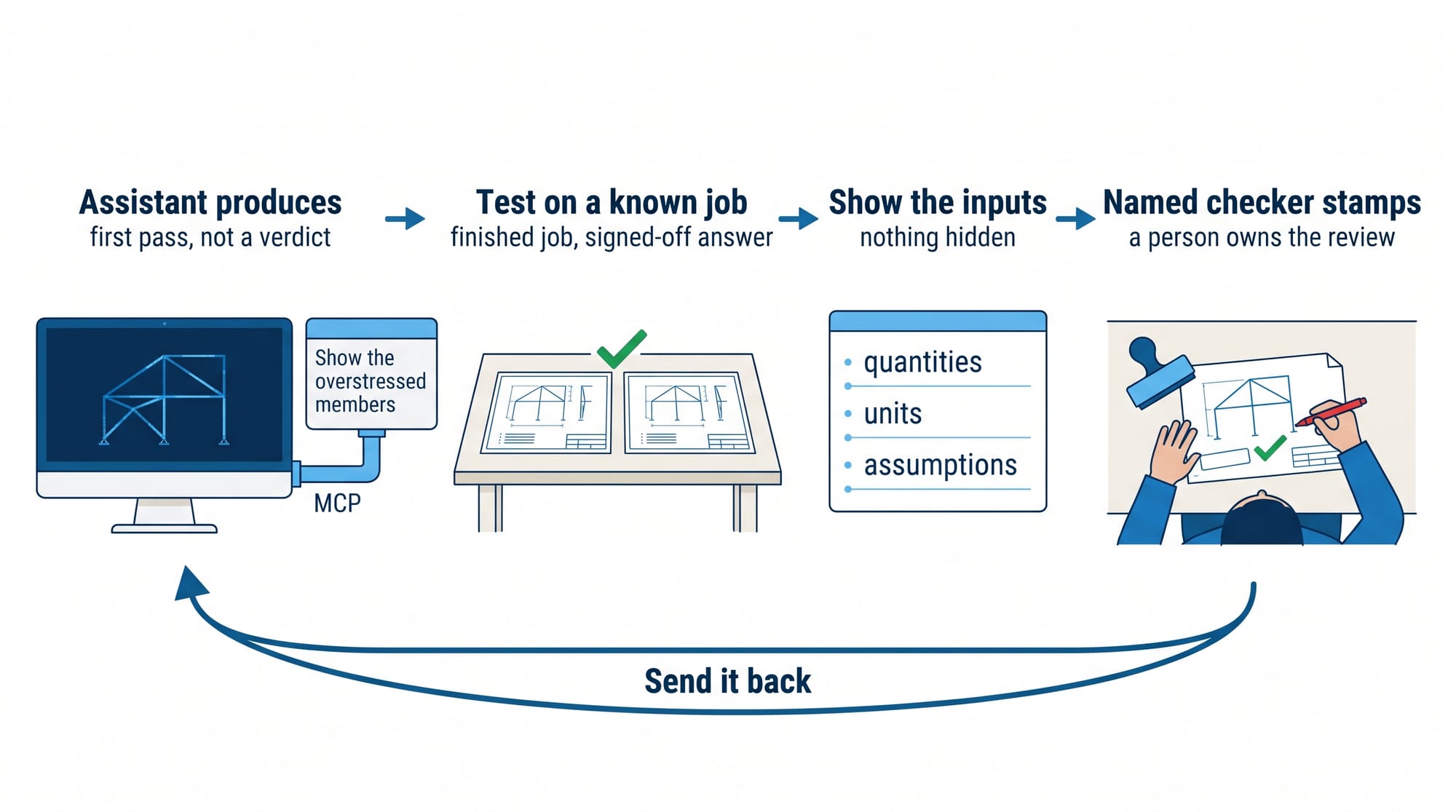
Bentley's AI can assist the work and flag issues, but it doesn't replace an independent check for mistakes. It runs the engineering inside the software you already trust, and a licensed engineer still checks every output before anything gets stamped. What changes is the speed of the first pass, not the standard of care.
Bentley's tools cover four familiar jobs: STAAD.Pro runs the structure, MicroStation draws and models it, ProjectWise holds the project information, OpenGround holds the ground data. What checks them is the same quality control you already run: independent check calcs, a named checker, the reviewer's stamp.
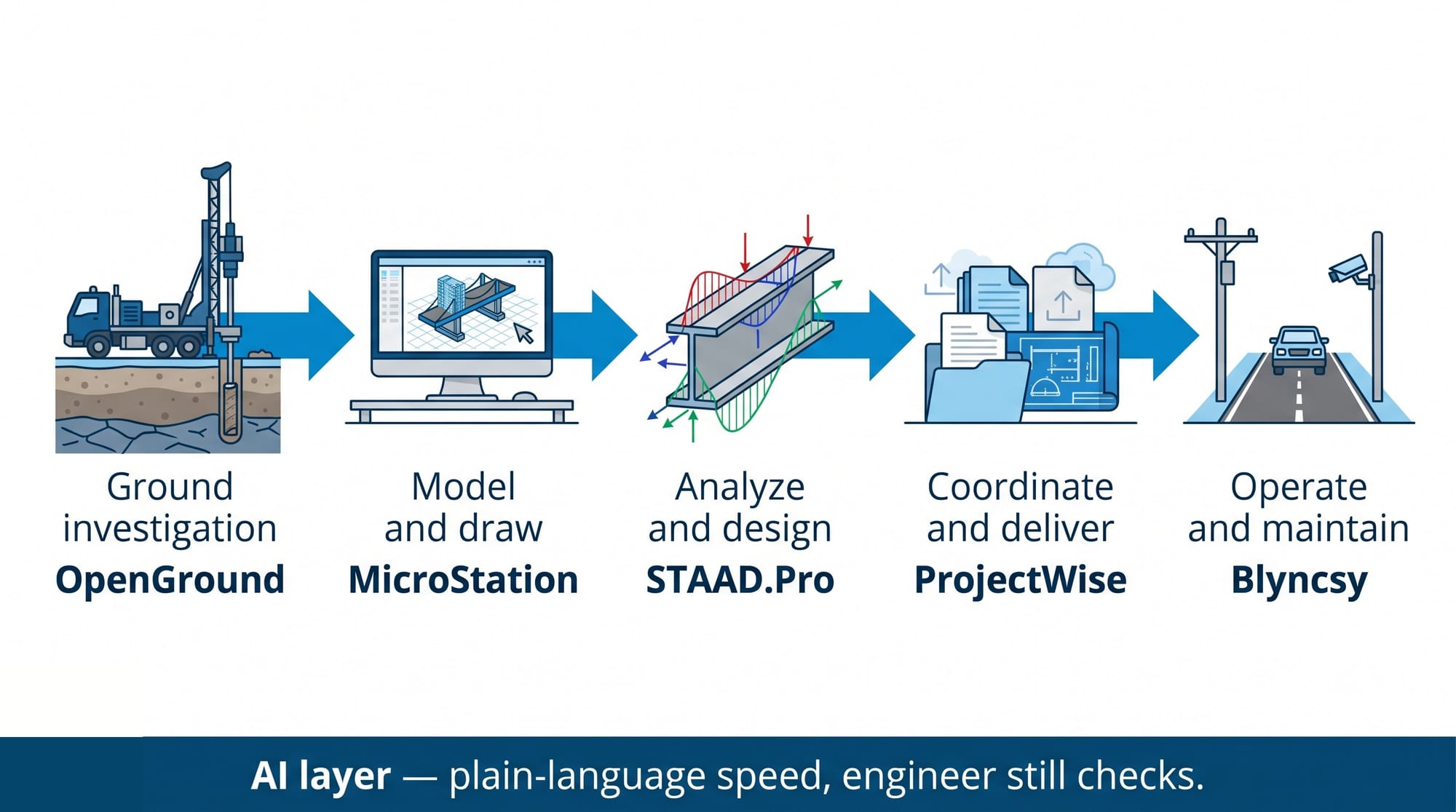
Faster software, same checking
Two workflows you already know, before any AI enters. First, you open a structural model in STAAD.Pro, check the members, loads, and results, then go to MicroStation when the geometry changes or the model becomes a drawing. Second, you go to ProjectWise for the current version, the approved issue, the agreed file, and to OpenGround when the question is what is in the ground: borings, lab results, the geotechnical record. That's where the AI enters: not as a new product to buy, and not as a reviewer, but as speed inside workflows you already run.
How it works
The mechanism is two Model Context Protocol servers, STAAD.Pro (included with STAAD.Pro 2026, and also open-source on GitHub) and MicroStation (Early Access, restricted users, not generally available): an assistant drives their software, and the software does the real engineering. The STAAD.Pro server lets an assistant (Claude, VS Code Copilot) query the model, run analyses, and iterate designs directly. Bentley reports a 40% reduction in steel weight from optimization of one production model. I haven't independently verified that result. Optimized members still need code checks, serviceability, and connection design reviewed by the engineer of record. The Gherkin was built the same way: the MicroStation server exposes MicroStation's Python API as tools an agent can call, inside a sandbox, and an assistant recreated its parametric geometry from a text prompt.
In plain language, MCP is the open plumbing that lets an assistant call the software's own tools instead of guessing at the model. You describe the task in plain language; the AI drives the actual validated software at machine speed.
Bentley's CTO Julien Moutte said: "This is not about hallucinating an engineering model from scratch; it's about executing real, verifiable engineering workflows." Plausible answers aren't enough for infrastructure: you need accuracy, transparency, and control.
Run the checking test on each tool. The STAAD server can run the analysis, compare a member against the code, and flag the one that fails. That is a check, and it is real. What it can't do is judge whether the model is right in the first place: whether the loads, the supports, and the assumptions match the structure that will actually get built. ProjectWise search can find the current version. It can't verify it. Blyncsy can flag a damaged guardrail. A person still decides whether the flag is right. Every tool here can run a check. None of them can be the checker.
Grading the launch
First, what Bentley launched is plumbing, not a product: STAAD.Pro 2026 includes an MCP server, and Bentley also distributes an open-source version. Confirm your version, setup requirements and support arrangements before piloting it. It still takes a technical hand to configure and pilot in your shop, but the server ships with the software you already license.
Second, the tools are free the way plumbing is free. The STAAD.Pro server ships with STAAD.Pro 2026 and is also free on GitHub, and the MicroStation server is in Early Access through a Bentley waiting list. What isn't free is everything underneath: the STAAD.Pro and MicroStation licenses the servers drive. "Free AI" here means free plumbing into software you already pay for.
Third, grade Bentley product by product, because the answer changed in 2026. ProjectWise AI-enhanced search has shipped inside the new ProjectWise Explorer, with Copilot chat in the search results. Copilot across the design apps is still arriving: Bentley said early 2026, so confirm with your rep what is live in your version. The drawing-annotation agent went generally available in November 2025. If your rep says "we launched AI," ask what is generally available today, in writing.
In the field: Blyncsy, Bentley's road-monitoring AI, was announced May 19: the Western Cape Department of Infrastructure will deploy it across roughly 5,000 km of South African roads, flagging damaged guardrails, missing signs, and faulty streetlights from dashcam imagery. That's the asset-inventory and condition piece: detections that belong in a Transportation Asset Management Plan or asset inventory, with a human quality assurance step.
At the Year in Infrastructure event (Oct 6 to 7, 2026), CEO Nicholas Cumins said nearly 70% of award finalists used AI. Juror Ananyaa Narain said the jury focused on how much of each workflow was automated, something they did not look for last year.
The win that isn't AI
The real 2026 win isn't AI at all. Bentley announced on April 29, 2026 that ProjectWise Design Integration and OpenGround achieved Federal Risk and Authorization Management Program authorization at the Moderate impact level, listed in the FedRAMP Marketplace under Bentley for Government since March 31, 2026. It was sponsored by the United States Army Corps of Engineers. That's the federal security bar for cloud products handling federal infrastructure data. If you sell to federal owners, this is the Bentley offering that cleared the bar. Compliance doesn't demo well on a keynote stage, but it decides procurements.
What tomorrow looks like
If it all worked tomorrow, your week doesn't lose paperwork. It gains a junior analyst who runs your software at machine speed and shows its work. A smaller, more honest promise than the packaged-agent pitch. And the junior analyst's work still gets checked by you.
Five questions before adopting
I haven't wired the STAAD server into a live model, so this brief grades the claims, not the tech. What I did is read the announcements, check the dates, and write the five questions I would ask before betting a project on it.
- Copilot and ProjectWise AI search: what is generally available today, with dates, not roadmap?
- Model Context Protocol in production: who is running the STAAD server on real projects, and what is the support model for open-source tooling?
- Western Cape: field results (detection rates, defect counts, not press-release adjectives)?
- Data: when the agent drives my model, what leaves the building?
- Can the detections export into my Transportation Asset Management Plan or asset inventory with a confidence score and a human quality assurance step?
If they can't answer all five, the evaluation isn't finished, whatever the demo looked like.
Your Monday-morning move, depending on which chair you sit in. Public owner: ask your IT or your consultant whether your project data environment meets FedRAMP Moderate. It's the federal bar. Ask which requirements apply to your agency, contract, data, and service. If you are a state Department of Transportation, ask whether your state's cloud policy points to FedRAMP or GovRAMP (formerly StateRAMP); this authorization shortens that conversation. That's a procurement question, not a tech question. Designer: the STAAD.Pro Model Context Protocol server is free and public on GitHub. Spend 15 minutes on the README. The real question isn't whether the tech works. It's whether your shop has the technical hands to pilot it.
So can AI check civil engineering work for errors? It can run the checks. It can't be the checker. That's Bentley's 2026: free plumbing, a mix of shipped features, previews and integrations, and compliance paperwork that matters for federal work. Respect the tools. Price the wiring. And keep the checking where it has always lived: with the engineer whose name goes on the drawing.
One question: when the AI runs the calc in your shop, who checks it: you, a named reviewer, or nobody yet? Hit reply.
P.S. Know someone weighing a platform decision right now? Forward them this brief.
Build systems, not stress. Joseph Dib, PE, PMP