A free self-guided workshop for civil engineers: the 5 Stages of AI Mastery
Every Monday, the same hour disappears.
You need a status report. The facts live in five places: last week's daily reports, the RFI log, the submittal log, the schedule update, and last week's report, which you open mainly to remember what you promised. So you hunt, copy, reconcile, and type. An hour, sometimes two, before the engineering starts.
Most engineers use AI somewhere inside that hour, usually to summarize one document or draft one paragraph. A 2025 Bluebeam survey of 1,000 architecture, engineering, and construction professionals, reported by ASCE, found only 27% use AI in their operations, and most of that use is the search-box kind: ask a question, get an answer, paste, move on.
That is not a tool problem. The tools are fine. It is a stage problem. There are five stages between "AI as a search box" and "AI prepares my Monday report," and almost everyone stops at the first one. So I built the workshop I could not find: a free self-guided workshop that walks civil engineers through all five, on project artifacts, with the checking discipline our profession already runs on.
It is called the 5 Stages of AI Mastery for Civil Engineering, and it is live on this site today. The article is free to read, no account needed. The slides and the practice files are for subscribers: join free and they are yours. https://www.infrastructure-catalyst.com/5-stages-of-ai-mastery-for-civil-engineering/
The stages, quickly:
Stage 0 is setup. An approved tool, a data rule (never upload what your agency has not cleared), and three folders: inputs, drafts, checked. Twenty minutes that prevent most of the ways this goes wrong.
Stage 1 is Ask. Get an answer, then verify it against the actual spec. The workshop exercise uses Caltrans Section 26 and the California Test methods, because an unnamed spec is how AI mixes three agencies' values into one confident paragraph.
Stage 2 is Think. Use AI as a sparring partner on a recovery plan built from real numbers: drainage down 4 days, an RFI open 19 days, two submittals overdue. Find the blind spots before the contractor does.
Stage 3 is Teach. Show AI what good looks like once, the way you would train a new engineer, and save it as a reusable skill. The worked example is a submittal review under Section 90, with Special Provisions controlling, the way your contract actually reads.
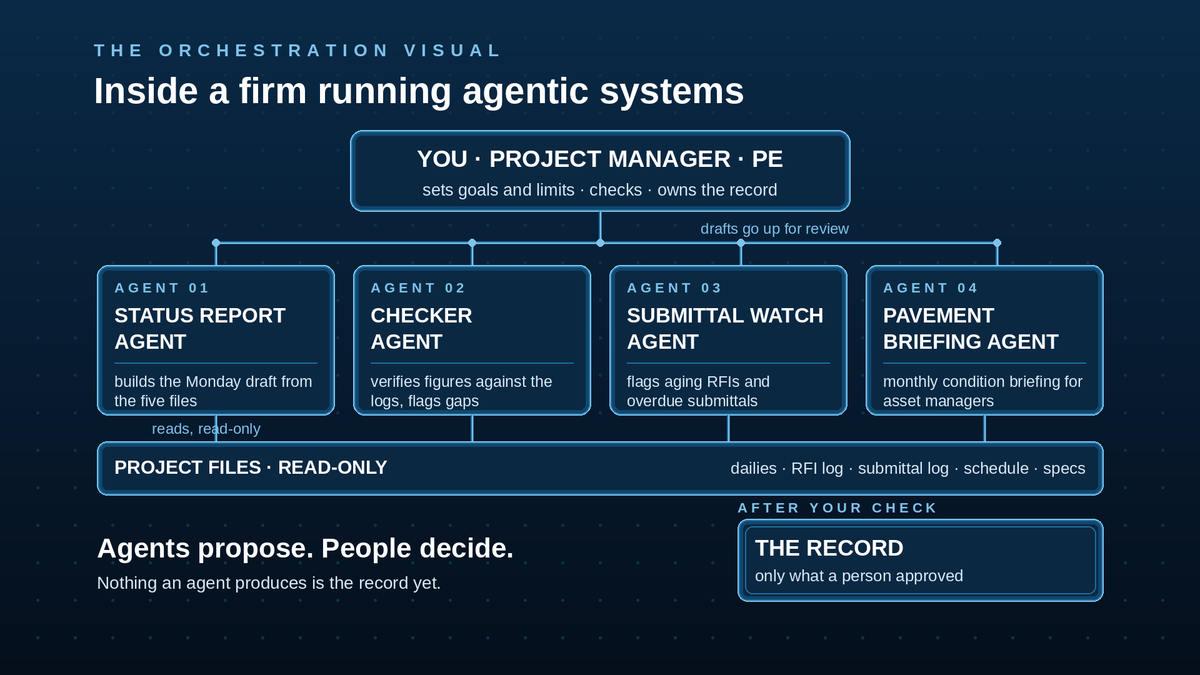
Stage 4 is Delegate. Hand over a meaningful unit of work: the Monday status report, assembled from the five files, with every figure checked against the logs. Asset managers get the same stage as a pavement condition briefing.
Stage 5 is Automate. Put the checked process on a schedule, read-only, so a draft is waiting Monday at 7:00 AM and your job is to check it and decide.
One rule runs through all six: AI drafts, you check, you own it. California law has a name for that ownership, responsible charge, and the workshop uses the real definition, because the accountability does not start at the stamp. It covers the status report and the RFI log too. AI will invent a spec section number that looks exactly right. It will average your pavement scores the wrong way. The workshop treats catching those as the core skill, not as a footnote, because that is the part of this transition our profession is actually built for. We already check other people's work for a living.
Make it yours, and run it with your team. The examples come from California public works because that is my desk. Give the workshop to your AI and ask it to adapt the examples, the specifications, and the exercises to your use case: your agency, your firm, your state. Then work it together, one stage at a time, as team training. A crew that runs the exercises together finds the use cases that matter to its own shop, and finds them faster than anyone working alone. The framework is adapted from Sabrina Ramonov's "5 Stages of AI Mastery." Everything else in it, the specs, the exercises, the checking rules, is from my desk.
The workshop ships with a practice pack: a fictional project, the Route 101 / Main St Interchange Improvements, with a week of daily reports, an RFI log, a submittal log, a schedule update, and a sample pavement export. The logs are seeded with the problems real logs have, so the exercises work before you ever point AI at a live project. The pack and the 39-slide deck are downloads for subscribers, on the site's Downloads page. Subscribing is free, and it is how I know who is actually using this.
Two requests. First, forward this to one engineer who is still using AI as a search box. Second, reply and tell me which stage you are at. I read every reply, and the answers decide what I build next.
Joseph Dib, PE, PMP
Infrastructure Catalyst