Anthropic launched Cowork. Microsoft quietly built it into M365 before most firms noticed

Infrastructure Catalyst
Issue #8 | March 09, 2026
Anthropic launched Cowork on January 12, 2026 as a research preview. Software stocks dropped $285 billion the same day. Microsoft had their own version embedded inside Microsoft 365 57 days later. Most infrastructure firms have not caught up to either announcement yet. That gap is exactly where the advantage is right now.
At a glance: two products, one brain, very different decisions
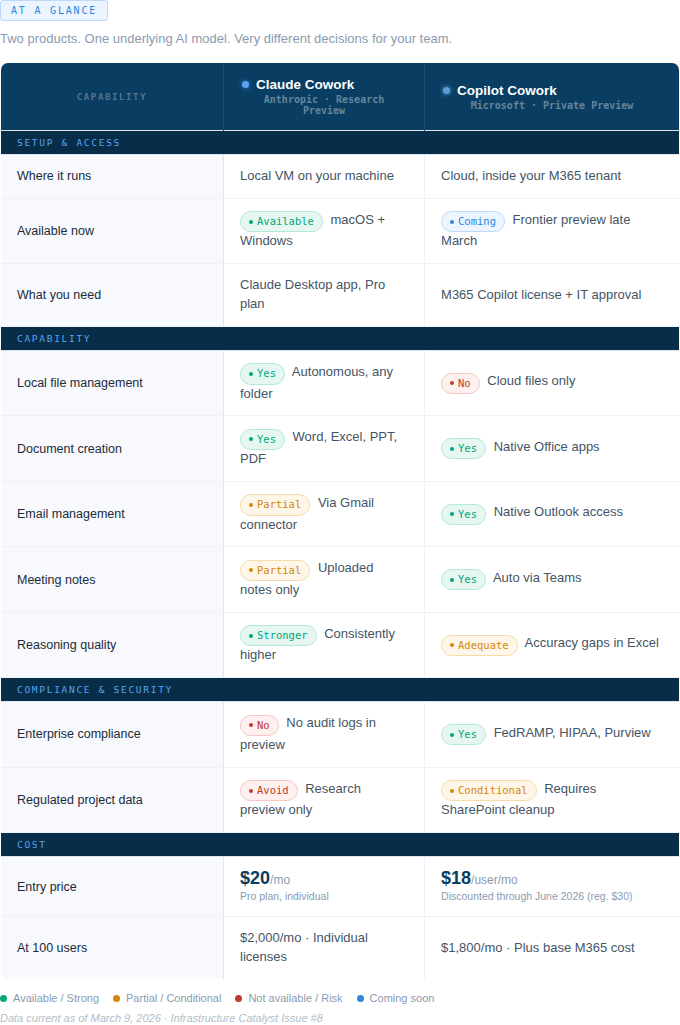
Both tools share the same underlying AI engine. The differences are in where they run, what they connect to, and how ready they are for regulated infrastructure work. The rest of this breakdown explains what those differences mean in practice.
Claude Cowork turns your desktop into an autonomous workspace
Anthropic launched Claude Cowork on January 12, 2026 as a research preview, a third mode inside the Claude Desktop app alongside Chat and Code. The intent is giving non-developers access to autonomous, multi-step task execution on their local machine.
When you open Cowork, you grant it scoped access to specific folders on your computer. Claude then operates inside a sandboxed Linux virtual machine where it can read, create, edit, and organize files without risking your broader system. You describe a task in plain language: "organize my Downloads folder by project," "turn these field notes into a formatted daily report," or "create a budget tracker in Excel from these invoices." Cowork breaks it into subtasks, executes autonomously, and delivers finished output files. You can watch its reasoning in real time and course-correct mid-task.
Core capabilities include direct local file manipulation across Word, Excel, PowerPoint, and PDF, scheduled recurring tasks such as daily cleanup and weekly report generation, and browser automation via the Claude in Chrome extension. The connector ecosystem includes Google Drive, Gmail, Slack, Asana, Notion, Salesforce, DocuSign, and hundreds more via MCP integrations. Anthropic launched plugins on January 30 with pre-built packages for finance, legal, HR, engineering, marketing, and sales, and opened the plugin system for custom builds without coding.
Pricing is straightforward. The Pro plan is $20/month. Max plans run $100 to $200/month for higher usage limits. Team and Enterprise tiers are also available. The free plan has no Cowork access. The tool is available on macOS and Windows, requires the Claude Desktop app, and has no web or mobile access.
Microsoft answered with Copilot Cowork 57 days later
On March 9, 2026, Microsoft unveiled Copilot Cowork as the centerpiece of Wave 3 of Microsoft 365 Copilot. The critical detail: it was built in close collaboration with Anthropic, using Claude's model and agentic architecture. Microsoft CMO for AI Jared Spataro called it "the new chat, the new way of interacting with AI."
The fundamental difference is architecture. Claude Cowork runs locally on your machine in a sandboxed VM. Copilot Cowork runs in the cloud within your Microsoft 365 tenant, with full enterprise data protection, compliance controls, and access to Microsoft's Work IQ intelligence layer. That includes your emails, files, calendar, meetings, and chats across all M365 apps. Charles Lamanna, Microsoft's President of Business Apps and Agents, described it as "much more like fire and forget" compared to traditional chat-based AI.
Copilot Cowork handles multi-step autonomous tasks across Microsoft 365. A single request can trigger it to assemble a presentation from SharePoint docs, pull financials from Excel, email the team a summary, and schedule prep time, all before your next meeting.
This sits within Microsoft's broader AI product family. Microsoft 365 Copilot costs $30/user/month as an add-on, currently discounted to $18/month through June 2026 for new business customers. It is embedded across Word, Excel, PowerPoint, Outlook, Teams, and SharePoint. Agent Mode is now generally available in Word, Excel, and PowerPoint, enabling active document editing rather than just suggestions. The Microsoft 365 E7 Frontier bundle at $99/user/month, generally available May 1, 2026, combines E5 licensing, Copilot, Agent 365 governance, and advanced security into a single package.
The adoption picture is mixed. Microsoft reports 15 million paid Copilot seats and 90% of Fortune 500 companies using its AI platforms. Gartner found that only 5% of Copilot pilot programs have scaled to full deployment. Users have noted accuracy issues in Excel calculations and Teams transcription. The $30/user/month flat rate with no volume discounts creates significant cost pressure at scale. For a firm with 5,000 employees, that is $1.8 million annually before the base M365 license cost.
What this means for infrastructure project managers
Neither tool replaces purpose-built construction PM software. For RFI management, submittal tracking, schedule optimization, and field documentation, industry-specific platforms remain the leaders. These include Procore AI, ALICE Technologies for generative scheduling, Civils.ai for engineering document intelligence, and Trunk Tools for field documentation. The general-purpose AI agents from Anthropic and Microsoft automate the office work around the project, not the project management itself.
That said, infrastructure PMs spend significant time on document-heavy tasks where these tools genuinely help. Daily report generation from field notes, specification synthesis across hundreds of pages, correspondence management for multi-stakeholder projects, and budget variance analysis in spreadsheets are all strong use cases today.
For individual PMs or smaller firms, Claude Cowork at $20/month is worth evaluating now, but for specific high-value tasks rather than general file dumping. The compelling cases are the ones that currently eat real time: taking a folder of subcontractor invoices and producing a formatted cost tracker in Excel with variance flags; pulling a week of field notes and drafting five daily log reports in the correct format; reading a 300-page specification and generating a structured submittal log with section references; or organizing a closeout package of drawings, RFIs, and punch lists into a logical archive structure. These are multi-step, document-heavy tasks where the local VM approach shines. What it is not is a replacement for Procore, a compliance tool, or anything involving sensitive client data during a research preview with no audit trail.
Known limitations that matter for regulated infrastructure work
Both tools carry real risks for engineering and infrastructure applications. Hallucination, generating plausible but incorrect information, is a critical concern where errors have safety and liability implications. Neither tool should produce final engineering calculations, contract interpretations, or compliance determinations without human review.
Claude Cowork's security posture is its biggest gap for enterprise use. Anthropic acknowledges prompt injection vulnerabilities, where malicious instructions hidden in documents can hijack the agent. The tool has no audit logs during the research preview, and Cowork activity is not captured in compliance APIs or data exports. Anthropic explicitly advises against using it for highly sensitive or regulated data. For public works agencies and firms handling government contracts, this is a significant barrier.
Microsoft's enterprise governance is substantially more mature. It includes Intune, Purview, DLP policies, Azure AD integration, session replay, and action logs for agent activity. However, Copilot inherits user permissions, which creates oversharing risks if SharePoint and OneDrive permissions are not properly governed. Organizations must clean up their data access controls before deploying Copilot, and many infrastructure firms have not done this work.
Resource consumption is another practical concern. A single complex Cowork session can consume quota equivalent to 50 to 100 standard Claude messages. Usage limits are the top complaint among Claude power users. Microsoft's flat $30/month pricing avoids this issue but creates budget pressure at organizational scale.
Is this the agentic moment, or just another pilot?
The convergence of these two products tells you something important. The Claude vs. Microsoft debate is collapsing faster than most people expected. The real question now is whether either product crosses the threshold from interesting demo to standard workflow.
We have seen promising agentic demos before: Claude Desktop with MCP connectors, ChatGPT's computer use features, and a long list of automation tools that generated real enthusiasm before running into the friction of real project environments. Most made a dent but did not change the baseline. Copilot Cowork, if it genuinely delivers Claude-quality autonomous reasoning inside a governed M365 environment at scale, would be different. It would be the first time a credible agentic AI product ships natively inside the software stack that most infrastructure firms already run.
Enterprise rollouts in regulated industries are slow. IT governance reviews, security assessments, data classification audits, and change management all stand between announcement day and the day your PMs actually use it. Some organizations will hold off indefinitely once they understand the prompt injection risks and the oversharing exposure that comes with deploying any agent that touches organizational data at scale.
The firms that move now are not moving recklessly. They are testing on low-risk, high-volume tasks, learning what works, and building the internal case before their leadership asks. By the time most infrastructure orgs are ready to deploy, those teams will already have six months of real-world experience with both tools. That is not a small gap to close.
If you want a step-by-step guide on how to set up Claude Cowork on your machine and get it running on a real project task, followed by how to configure Microsoft Copilot when it becomes available to your org, comment "Cowork" below and I will put it together.
Joseph Dib, PE, PMP